
DECA
Driveshaft
2-channel telemetry for driveshafts, with a battery-powered rotor unit on the shaft.
The measuring chain, accuracy and outputs of DECA Telemetry, designed for propshafts and sideshafts.
2-channel telemetry with a battery-powered rotor unit for driveshafts.
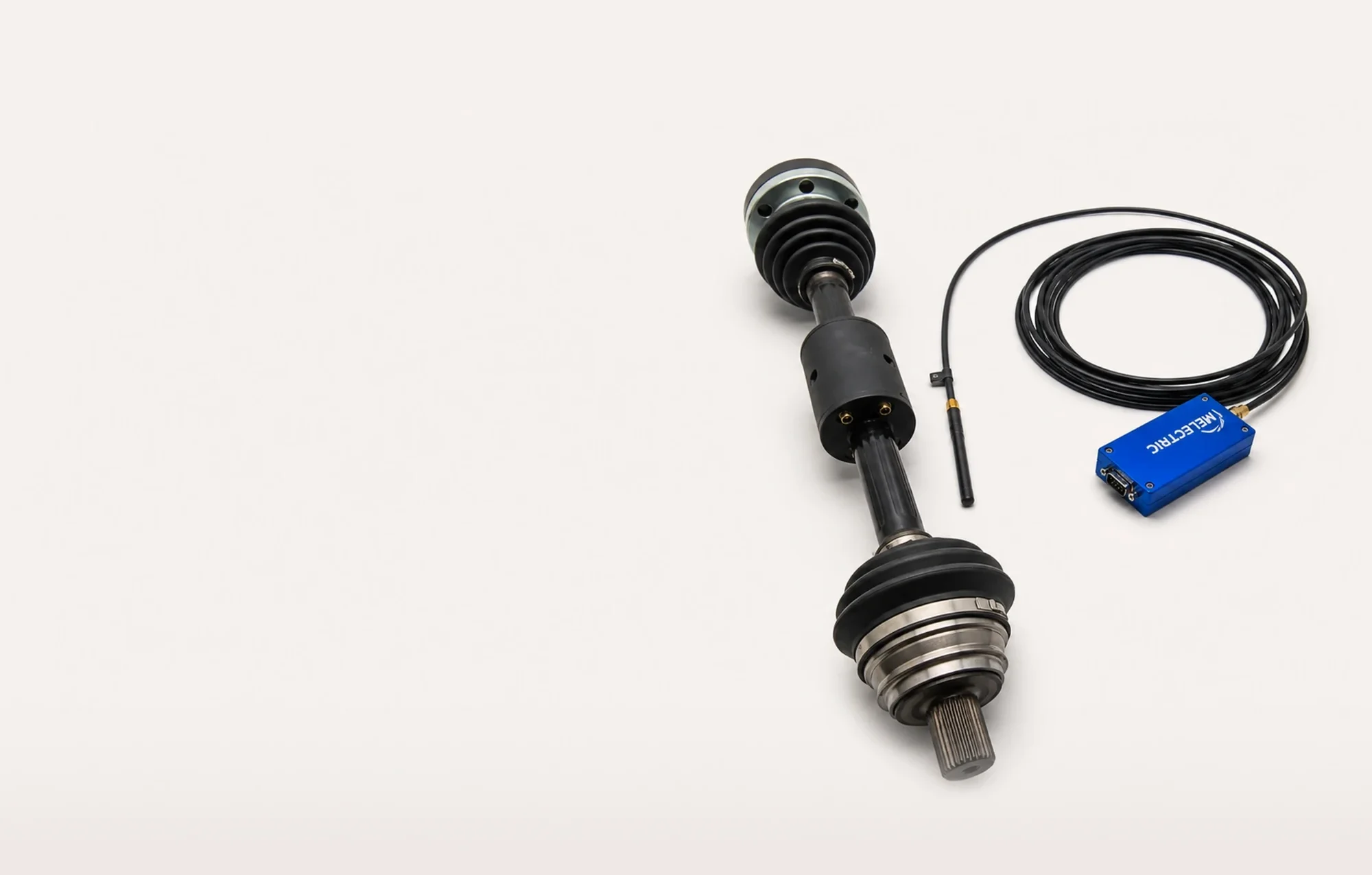
DECA Driveshaft is the driveshaft variant of the DECA telemetry system. Measuring chain, signal accuracy, outputs and radio link match DECA Telemetry; the rotor unit is designed to mount on propshafts and sideshafts.
Power comes from a battery that turns with the shaft. Sensors, electronics and supply therefore sit entirely on the shaft, and the readings travel to the receiver by radio.
Rotor unit, radio link and outputs.
| Feature | Value |
|---|---|
| Measuring channels | 2 sensor channels |
| Rotor unit | Designed for propshafts and sideshafts, mounted on the existing part |
| Power supply | Battery on the shaft, turning with it |
| Wireless data transmission | Wireless signal transmission up to 15 m |
| Signal outputs | Analogue: ±5 V, ±10 V, 4–20 mA | Digital: CAN bus |
| Signal accuracy | up to 0.05 % FS |
| Temperature range | −40 to 105 °C |
| Ingress protection | IP67, suitable for harsh ambient conditions |
Measurement in the driveline
Typical measuring tasks solved with this series. The list is not exhaustive.
Vehicle development and motorsport
- Torque measurement on propshafts and sideshafts while driving
- Setting up driveline, traction and torque distribution
- Load data from testing, with no cable to the rotating side
Test bench and field measurement
- Capturing load spectra on driveshafts over longer measuring runs
- Measurements on existing shafts, with no extra shaft in the load path
- Use in harsh environments with wet, dust and vibration
Supply and sensors on the shaft
Battery on the rotating side
No power transfer to the shaft is needed, the rotor unit works on its own
Rotor for driveshafts
A mount for propshafts and sideshafts, applied to the existing part
The DECA measuring chain
Accuracy, signal outputs and radio link are unchanged
Technical enquiry about your application.
Shaft geometry, torque range, speed and measuring duration are enough for a first design proposal.